
Blog

A Watershed Moment for HR Leaders: What the Employment Rights Act 2025 Means for Your Hiring Strategy Right Now

A letter from us to you in partnership with the REC

Dear HR Leader,

I am writing to you as an HR leader responsible for workforce planning and employment compliance, because the legislative landscape governing how you hire, manage, and retain employees is changing more significantly than at any point since the Recruitment Agencies Act 1973. The changes I outline below are not theoretical; several are already in force, and others carry deadlines that, once passed, will reshape your exposure to legal risk materially and permanently.

At Touchscreen Talent, we specialise in placing Technology, AI, and Digital Transformation talent. Our clients rely on us not only to find the right people, but to understand the environment in which those people are hired. This letter reflects both roles.

The Unfair Dismissal Changes: Why July 2026 Is the Critical Hiring Date

The most urgent issue for your immediate attention concerns unfair dismissal. From 1st January 2027, under the Employment Rights Act 2025, the qualifying period for an employee to bring an unfair dismissal claim will be reduced from two years to six months. Simultaneously, the cap on compensatory awards, currently the lower of £123,543 or 52 weeks’ gross pay, will be removed entirely.

The practical implication is straightforward and demands action now. Any employee you take on before 1st July 2026 will have accrued the six-month qualifying period by 1st January 2027 and will therefore have full statutory protection from that date. Anyone hired from July onwards will cross the six-month threshold during the course of 2027. There is no grace period and no transition arrangement.

This is not a future problem. For HR teams managing permanent headcount decisions in H2 2026, every new hire made from this point onwards enters your organisation under a materially different risk profile than hires made prior to this year. The removal of the compensation cap is particularly significant for senior Technology and Digital Transformation appointments, where salaries and therefore potential award values are high.

The practical steps recommended ahead of January 2027 include a thorough review of your disciplinary and grievance procedures, ensuring they are documented and communicated to employees; a structured approach to probationary periods that includes regular feedback and recorded performance conversations; and an audit of any informal management practices that have not previously been tested against a six-month qualifying threshold.

There is also a commercial dimension worth considering. Some organisations, cautious about direct hiring in this environment, may look more favourably at interim and contract arrangements, or at temp-to-perm models that allow performance to be assessed before permanent employment is confirmed. For those hiring Tech and Digital talent, where skills are highly specialised and the cost of a poor hire is significant, this approach has genuine merit.

Guaranteed Hours: A Consultation That Demands Your Input

The Employment Rights Act 2025 also introduces a framework of guaranteed hours rights for workers on zero-hours and low-hours contracts. The Government is currently consulting on the detail of the provisions, with the consultation closing on 25th August 2026. The implementation date for guaranteed hours rights is expected to fall in 2027, though no specific date has been confirmed.

Under the proposals, employers will be required to offer workers guaranteed hours reflecting the hours they have regularly worked over a defined reference period. The Government’s preferred reference period is 12 weeks, though options of 26 and 52 weeks are also under consultation. Employers will also be required to provide reasonable notice of shifts and cancellations, with a statutory presumption of between one and four weeks’ notice, and to make payments where shifts are cancelled, moved, or curtailed at short notice, at rates ranging from 10% to 80% of lost earnings depending on timing and severity.

For organisations using flexible or contingent labour, including contract Technology and Digital resources, it is important to understand that the Act creates a separate but similar regime for agency workers. Under this regime, the obligation to provide guaranteed hours sits with the hirer, while both the agency and the hirer share responsibility for reasonable notice. The consultation also includes a proposal to exempt agency workers from guaranteed hours rights where their agency contract already guarantees them hours above a specified threshold, though the level of that threshold remains under discussion.

The REC has argued strongly for a full exemption for genuinely temporary workers, as is the case in the Irish system, and has further argued that if agencies are included, the reference period should be 52 weeks rather than 12, to distinguish stable patterns from seasonal variation. These are the positions being put to Government. Whether or not they are adopted, the compliance and contractual obligations flowing from this legislation will require careful planning by HR functions that engage flexible workforces.

Right to Work: Changes Taking Effect from October 2026

From October 2026, the legislation governing Right to Work checks will change substantially. The Home Office is amending the Immigration, Asylum and Nationality Act 2006 to extend the illegal working regime beyond direct employees to a much wider category of working arrangements. This will include individuals engaged under a worker’s contract (limb (b) workers), individual subcontractors in supply chains, and online matching platforms that introduce service providers to clients.

Crucially, responsibility for Right to Work checks will no longer rest solely with the direct employer. Clients who engage recruitment agencies for temporary supply work may still be treated as responsible for those workers and can be found liable if the workers do not have the right to work in the UK. A code of practice and employer guidance is being developed by the Home Office, but the new obligations will be in force from October regardless.

The REC’s position, in its response to the consultation, is that checks must not be unnecessarily burdensome, particularly for smaller businesses; that existing regulatory frameworks such as the Conduct Regulations already provide a foundation; and that additional identity checks must not disproportionately affect UK nationals. The REC is also pressing the Home Office directly on this point and engaging with the Home Secretary.

For HR leaders and procurement teams, the practical implication is that your existing supplier agreements with staffing agencies should be reviewed to understand where Right to Work liability sits, and your internal processes for onboarding contingent workers may need to be revisited before October. The Government has also stated an ambition to move Right to Work checks entirely to digital by the end of this Parliament, which, when delivered, should reduce the administrative burden considerably.

The Wider Picture: A Labour Market Under Pressure

These legislative changes are landing in a labour market that is already under strain. The most recent KPMG and REC Report on Jobs, published in June 2026, reported the quickest fall in permanent placements for ten months in May, driven by heightened uncertainty linked to global pressures and domestic employment law changes. Employers are increasingly leaning on temporary and contract staffing to maintain flexibility, with temporary billings rising at their fastest rate in over three years.

This is particularly relevant for Technology, AI, and Digital Transformation hiring. Permanent placement volumes in technical disciplines are falling at pace. The pool of available candidates is larger than it has been for some time, owing to redundancies and reduced demand. Yet the risk profile attached to permanent hiring has increased, as the unfair dismissal changes take effect. The combination of greater candidate availability, sharper legislative risk, and continued demand for specialist skills creates an environment in which getting hiring decisions right, and getting them right quickly, matters more than it has for years.

Looking Ahead

The Employment Rights Act 2025 is the most significant reshaping of UK employment law in over half a century. It affects not only how you hire but how you manage, what you owe to flexible workers, how you conduct Right to Work checks, and how much financial exposure you carry when employment relationships end badly.

As you consider your workforce plans for the remainder of 2026 and into 2027, I would invite you to reflect on a number of questions.

Have you reviewed your probationary processes and management documentation in light of the January 2027 unfair dismissal changes, and do you have confidence that they would withstand tribunal scrutiny at the six-month mark rather than the two-year mark? Have you assessed your exposure to guaranteed hours obligations across your contingent workforce, and do you understand how your staffing agency relationships will need to evolve once those provisions come into force? Are your Right to Work processes and supplier contracts ready for the October 2026 changes, and do you know where liability will sit if a check is not completed correctly? And given that permanent hiring in Technology and Digital disciplines is slowing whilst candidate availability increases, are you taking advantage of the current market conditions to secure the talent your organisation needs for the next phase of its transformation?

If any of these questions would benefit from a conversation, I would be glad to help. Touchscreen Talent works exclusively in Technology, AI, and Digital Transformation, and we combine deep market knowledge with an understanding of the legal environment in which our clients operate.

You can find out more about us at www.touchscreentalent.co.uk.

Yours sincerely,

Simon
Guaranteed Hours: The Law That Changes Everything

The Employment Rights Act 2025 is the most significant overhaul of UK employment law in a generation. With the Government set to mandate guaranteed hours for flexible workers, the ripple effects on businesses, youth employment and the skills pipeline call for a tougher and more transparent conversation.

On 18 December 2025, a piece of legislation quietly became law that will, in practice, reshape how hundreds of thousands of UK businesses plan, hire, and operate. The Employment Rights Act 2025, the centrepiece of the Government’s Make Work Pay agenda, received Royal Assent with relatively modest fanfare. Yet its implications extend far beyond the headline promise of “ending exploitative zero-hours contracts.” For businesses navigating the demands of digital transformation and AI adoption, for young people entering a rapidly evolving labour market, and for the talent ecosystem that Touchscreen Talent exists to serve, this legislation is a watershed moment.

At Touchscreen Talent, we do not deal in abstractions. Our clients are technology and digital transformation businesses including ambitious SMEs to established enterprise teams who depend on flexible, responsive talent strategies to compete. This article examines, honestly and with evidence, what the guaranteed hours provisions will mean in practice: who wins, who loses, and what the legislation fails to address.

What the Law Actually Says

It is worth beginning with precision, because much of the current commentary conflates the legislation’s ambition with its actual mechanism. The Employment Rights Act 2025 does not ban zero-hours contracts outright. What it introduces, from 2027 and subject to further secondary legislation, is a right for qualifying workers to be offered guaranteed hours that reflect the hours they have actually worked during a reference period, expected to be twelve weeks.

A worker becomes a “qualifying worker” once they have worked a consistent pattern through that reference period on a zero-hours or low-hours contract. At that point, their employer is legally obligated to make them an offer of guaranteed hours. Critically, the worker may accept or decline. The flexibility, for those who genuinely want it, is preserved — at least on paper.

Legislative Mechanism

The Act requires employers to make a guaranteed hours offer after every reference period (expected: 12 weeks) where a qualifying worker has worked hours exceeding their contractual minimum. Employers can limit the offer to a defined period if they can demonstrate a genuine temporary need. Workers may accept or reject the offer. Failure to make the required offer exposes employers to Employment Tribunal claims.

Alongside guaranteed hours, the Act mandates reasonable notice of shifts and financial compensation for short-notice cancellations or curtailments. Specific definitions of “reasonable” remain subject to secondary legislation.

Implementation is staged. The first wave of reforms, including statutory sick pay from day one and enhanced parental leave rights, landed in April 2026. The guaranteed hours and zero-hours provisions, along with the reduction in the unfair dismissal qualifying period from two years to six months, are scheduled for 2027. Businesses have time. But the window is narrower than it appears, particularly for those that have not yet audited their flexible workforce arrangements.

The Numbers Behind the Debate

The scale of what this legislation affects is frequently understated. According to the Work Foundation at Lancaster University, drawing on ONS Labour Force Survey data, 1.23 million people in the UK are now on zero-hours contracts as their primary form of employment, the highest figure ever recorded, representing a 91,000 increase in a single year. That growth has accelerated, not slowed, in the two years since Labour’s election victory.

The demographic picture is stark. One in eight workers aged 16 to 24 ( 12.6% ) is on a zero-hours contract, compared with just 2.44% of those aged 25 and over. Young people are 5.1 times more likely to be engaged on this basis than any other age group. The sectoral concentration is equally telling: accommodation and food services carry the highest proportion at 28.8% of their entire workforce, followed by health and social care at 16.8%. These are not peripheral or marginal arrangements, they represent the structural operating model of entire industries.

The geographic dimension matters too, particularly for Touchscreen Talent’s clients across the Midlands and England more broadly. The East Midlands sits at 4.2% above the UK national average of 3.4%. Meaning the local employer base is meaningfully more exposed to these changes than the national headline suggests.

The Case for the Legislation

There is a genuine problem that the Act is attempting to address. A third of all zero-hours contract workers (32.8%), a record high according to the Work Foundation, are entirely dependent on them for full-time income, with many wanting both more hours and greater predictability. This is not voluntary flexibility. It is structural insecurity being borne disproportionately by the youngest, the least financially resilient, and predominantly female workers.

For businesses, there is also a self-interest argument. High turnover is expensive. Research consistently shows that workers with greater income security demonstrate stronger engagement, lower absenteeism, and longer tenure. A three-quarters majority of workers in the industry trials cited in Parliamentary evidence opted to accept guaranteed hours when genuinely offered. The market itself, given the choice, gravitates toward stability.

The Case Against — And the Flaws No One Wants to Name

The practical objections, however, are not trivial, and businesses raising them are not simply resisting worker rights. The twelve-week reference period is the legislation’s Achilles’ heel in any sector with genuine seasonality. UKHospitality made this case compellingly in its Parliamentary submission: a worker who begins employment in late November (peak Christmas trading) will generate a twelve-week average that is fundamentally unrepresentative of the role’s typical demands. The pub sector’s data showed a 15% drop in hours worked in January compared to December, representing approximately 329,000 fewer hours. At the current National Living Wage, guaranteeing those hours into quieter trading periods equates to over £4 million in additional labour costs for the sector in a single month : for hours neither needed nor requested.

For SMEs in digital transformation and technology (Touchscreen Talent’s core market) the parallel risk is different but equally real. Project-based work, sprint cycles, and client-contingent demand mean that flexible resourcing is not an exploitation strategy; it is an operational necessity. A twelve-week reference period during an intensive delivery phase could commit a business to headcount levels that simply do not reflect their structural requirement. The Act contains no general size exemption: SMEs face exactly the same legal duties as large employers, with significantly fewer resources to absorb compliance costs or manage tribunal exposure.

Crucially, from January 2027 the unfair dismissal qualifying period drops to six months, and the compensatory award cap is removed entirely. These reforms, layered on top of guaranteed hours obligations, fundamentally change the risk calculus of every hire. For a growth‑stage technology business built on rapid and flexible hiring, this is not a minor issue. It is a strategic challenge.

The Skills Paradox: When the Law Meets the Gap

The UK is simultaneously facing one of the most persistent skills shortages in its modern history while producing, through its education system, record numbers of technically qualified young people. ManpowerGroup’s 2025 Talent Shortage Survey found that 76% of UK employers still cannot fill roles due to a lack of skilled talent. The Open University’s Business Barometer 2024 put the figure at 62% of organisations struggling to find workers with the right skills. The Government’s own Employer Skills Survey 2024 confirmed that 27% of all vacancies in the UK are hard-to-fill due to skills deficits, and while that is an improvement on 2022’s 36%, it remains structurally embedded. Just think how this will impact future growth?

Yet when employers are asked what those deficits actually look like, a striking and underreported pattern emerges. The skills that are hardest to find are not always the most technical. More than 70% of UK employers report that college and university leavers are inadequately prepared for the demands of the workforce. Not because of coding deficiencies, but because of gaps in communication, resilience, collaboration, and emotional intelligence.

The STEM Paradox

The UK has invested heavily in STEM education for over a decade, and that investment has produced measurable results. Programming is now taught from primary school. Computer science is a core subject. The digital talent pipeline, in raw graduate terms, has never been fuller. Yet approximately 90% of UK employers now consider soft skills to be crucial, and surveys consistently identify emotional intelligence, adaptability, and interpersonal communication as the most acute shortfalls.

This is not a coincidence. It is a structural consequence of the way education has been oriented. Children and young people have been trained for a technically demanding future. They have been examined on algorithms, not on how to handle ambiguity. They have been assessed on code reviews, not always on how to disagree constructively in a team. The IET’s 2023 survey found that 62% of employers believe the skills shortage is having a significant impact on their business and within that, the evidence points consistently to a soft-skills deficit that technical qualifications do not address. The question is, will reduced levels of hiring throughout 2025 and so far in 2026, positively impact this gap and is AI an answer?

Zero-hours and flexible entry-level roles have, whether intentionally or not, served a development function here. They have been the mechanism through which young people in hospitality, retail, and services have developed the human skills that no classroom teaches: managing a difficult customer, working under pressure with a team they barely know, navigating workplace politics, exercising judgement without supervision. These are not incidental benefits. They are foundational to career progression in any sector including, emphatically, digital transformation and AI, where client-facing roles, cross-functional teamwork, and change management are as critical as technical capability.

What Guaranteed Hours May Inadvertently Take Away

The CIPD, arguably the most authoritative voice on UK workforce practice, has raised precisely this concern. In a June 2026 report on youth unemployment, the CIPD noted that proposed minimum guaranteed hours for zero-hours workers may affect the flexible roles that many young people rely on to balance work and study, and encouraged Government to consider these impacts carefully before finalising secondary legislation.

The mechanism is not counterintuitive. If a business knows that offering a flexible role to a student creates a twelve-week clock after which it must provide guaranteed hours; with the associated administrative, legal, and financial obligations. It faces a rational incentive to either not hire at entry level, or to restructure those roles in ways that exclude younger workers entirely. A student who wants ten hours a week during term time and thirty hours during the summer is precisely the person this legislation was not designed to harm. But they may be the person it harms most.

The number of young people not in employment, education, or training has now passed one million in the UK. The CIPD’s warning is timely: the cure must not accelerate the disease.

The Flexible Workforce in Tech: A Sector-Specific Reality

Digital transformation businesses occupy unusual terrain in this debate. They are, in many respects, the least likely to rely on zero-hours contracts in the traditional sense. Their talent strategies more commonly involve permanent roles, fixed-term contracts, and specialist contractors. But the Employment Rights Act’s implications ripple further than zero-hours arrangements alone, and technology businesses are not insulated.

The reduction in the unfair dismissal qualifying period affects every business’s hiring risk profile. The fire-and-rehire provisions constrain the flexibility to renegotiate contract terms as roles evolve. At times, this has been a common occurrence in fast-moving technology environments where job descriptions can be genuinely outdated within months. The guaranteed hours mechanism, while primarily targeted at hourly-paid roles, creates a precedent and administrative apparatus that reflects a broader regulatory tightening of the employment relationship.

For Touchscreen Talent’s clients, the more immediate strategic question is this: if the cost and complexity of direct employment rises, and the flexibility of direct hiring narrows, what happens to your talent strategy? The evidence from previous regulatory tightening such as IR35 reforms, Agency Workers Regulations suggests businesses do not abandon flexible workforce models. They restructure them, sometimes in ways that produce worse outcomes for workers than the arrangements they replaced.

The Seasonal Hiring Problem No One Has Solved

Seasonal employment is not a quirk of the economy. As we approach our summer period it has been a structural feature of how significant parts of the UK’s productive capacity operates. Tourism, agriculture, retail, entertainment, and events all depend on it. The twelve-week reference period, as currently designed, does not accommodate genuine seasonal fluctuation with any elegance.

The Act does provide a limited carve-out: an employer may restrict the guaranteed hours offer to a defined period if it can demonstrate the need for work is genuinely temporary. But the legal standard for what constitutes a satisfactory demonstration remains undefined, subject to secondary legislation, and likely to generate significant Employment Tribunal litigation before any settled interpretation emerges.

For businesses in the Midlands and across England that depend on seasonal talent such as: technology events, summer internship programmes, Christmas retail support, the coming twelve months represent a critical planning horizon. The legislation is not yet fully in force, but its direction of travel is established. Businesses that have not yet mapped their workforce against it are already behind.

The Harder Question: Are We Asking the Right Thing of Legislation?

There is a broader intellectual problem running beneath this debate that rarely surfaces in the trade press or parliamentary submissions. The Employment Rights Act 2025 attempts to address income insecurity and workplace exploitation through the mechanism of contractual obligation. It says, in effect: if a worker has been showing up regularly, they deserve a contract that reflects that reality. This is reasonable and defensible.

But it cannot, by itself, address the skills deficit. It cannot develop emotional intelligence in young people who spent their formative educational years optimising for STEM examinations. It cannot replace the sociological value of entry-level service work as a crucible for human skills development. And it cannot resolve the tension between a labour market that increasingly rewards cognitive and interpersonal capability, and an education system that still largely assesses analytical performance.

The UK’s skills gap costs between £30 to £39 billion annually in lost GDP and productivity, with projections reaching £120 billion by 2030 if unaddressed. Digital skills gaps alone account for £63 billion annually. These are not figures that can be legislated away. They require a long-term, system-level response: in curriculum design, in employer investment (which has fallen 29.5% per employee since 2011), and in how we value and develop the human capabilities that make technically skilled workers genuinely effective in teams.

Legislation that inadvertently narrows the entry points through which young people develop those capabilities (the weekend pub job, the holiday retail shift, the zero-hours event staffing role) may solve one problem while creating another, larger one a decade from now.

What Businesses Should Do: An Evidence-Based Response

Touchscreen Talent’s position is not to oppose reform. The data on zero-hours exploitation is real, the income insecurity is real, and the disproportionate impact on young women and minority workers is real. But good policy requires honest implementation, and honest implementation requires that businesses in our space act with both intelligence and urgency.

Before 2027, the evidence points clearly to four priorities for technology and digital transformation employers:

Audit your flexible workforce now. Map every worker on variable hours against the twelve-week reference period logic. Identify who would qualify, what guaranteed hours would look like for them, and what the cost exposure is. This is not optional, it is foundational.

Rethink your hiring risk model. With the unfair dismissal qualifying period dropping to six months and compensatory awards uncapped, the standard of hiring decision-making and early-employment documentation must rise. Businesses that have relied on the two-year window as a risk buffer need new frameworks.

Invest deliberately in soft skills development. The skills shortages that employers consistently cite; emotional intelligence, communication, leadership under uncertainty, are not going to be solved by the next cohort of STEM graduates. Businesses that build structured development pathways for these capabilities will be recruiting from a larger effective talent pool than their competitors who do not.

Engage specialist recruitment intelligence early. The businesses that navigate this transition best will not be those that react to legislation once it arrives. They will be those that have worked with recruitment partners who understand both the regulatory landscape and the talent market well enough to build workforce strategies that are both compliant and competitive.

The Employment Rights Act 2025 is not, at its heart, bad legislation. The problem it identifies, one-sided flexibility that exploits the most vulnerable workers, is genuine and well-evidenced. But law is a blunt instrument, and the real world is not built to the geometry of twelve-week reference periods. The businesses that will thrive in the post-2027 landscape are those that engage with the complexity honestly: who protect their workers, invest in their development, and build talent architectures that reflect both what the law requires and what the economy actually needs.

At Touchscreen Talent, this is precisely the territory we inhabit. The intersection of regulatory change, digital transformation demand, and skills supply is not an abstract policy space. It is the practical reality our clients navigate every quarter. We exist to help them navigate it well and now have capacity to help you. Contact us for more details.

How AI is Transforming Innovation at Touchscreen Talent

The irreplaceable human touch that makes recruitment truly work. Smarter tools. Sharper thinking.

There is a question that sits quietly at the heart of every conversation about artificial intelligence: what, precisely, are we trying to improve? Efficiency? Output? Speed? All of those, certainly. But in the world of talent and recruitment, there is something more fundamental at stake, the quality of human connection. This is where things get genuinely interesting.

At Touchscreen Talent, we have spent considerable time thinking about this. Not just as a practical matter of adopting new tools, but as a philosophical exercise. Because when you operate in a space where your entire purpose is to connect the right person with the right opportunity, you cannot afford to let technology become a substitute for judgement. What you can do and what we are doing is use it to become sharper, faster, more informed, and ultimately more human in the moments that count.

We’ll walk you through how AI has transformed the way we work, and why we believe the future of recruitment is not reliant on artificial intelligence or human expertise per se, it is both, in careful, considered balance.

The World Moved On. We Moved With It.

Recruitment has always been an information-dense profession. Dozens of roles live simultaneously, each with its own brief, its own nuance, its own cast of candidates. Hiring managers want speed. Candidates want personalisation. Compliance demands rigour. And somewhere in the middle of all of that, you need to find time to actually think and run a business.

For years, the industry’s answer to this pressure was simply to work harder and hire more people. But that model has a ceiling, and most of us have hit it. The smarter answer, the one we have leaned into at Touchscreen Talent, is to work more intelligently. To let machines handle what machines do brilliantly, so that people can focus on what only people can do.

That shift has not happened overnight. It has been deliberate, incremental, and always guided by a single principle: AI is the engine; the human being is the driver. Humans think about the business improvements and get machines to do the heavy lifting.

Rather than speak in abstractions, let us be specific. Here are the eight areas where AI has made a tangible, measurable difference to the way Touchscreen Talent operates and, crucially, how each one still requires a human hand on the wheel.

01
Content Creation & Engagement

AI helps us produce compelling, on-brand written content at pace. Adverts, outreach messages, social posts, and candidate communications. But tone, timing, and authenticity? Those remain human decisions. A well-crafted message that resonates is never purely algorithmic.
02
Job Specification Production

Producing a great job specification used to take hours of back-and-forth. AI drafts a structured, compliant starting point in minutes, drawing on role-type intelligence and sector knowledge. Using our experience we then refine it. Ensuring it reflects the real culture and authentic needs of the hiring organisation.

03
Efficiency Gains & Automation

Scheduling, follow-up sequencing, document formatting, status updates to name a few.
The administrative layer of recruitment is significant. Automating these tasks has returned genuine time to us. Time now spent on conversations, relationships, and strategy.

04
Candidate Intelligence & screening

AI assists in processing large volumes of applications and surfacing relevant profiles based on structured criteria. It does not make the decision, we do, using our experience, intuition, and understanding of the client’s specific context to make the final call.

05
Note-Taking & Interview Documentation

AI transcription and summarisation tools mean that we are no longer split between listening and writing during candidate interviews. We’re fully present in the conversation, which is where the real insight lives, and review an accurate, structured summary afterwards.
06
Research & Market Intelligence

Understanding a client’s sector, competitive landscape, and talent pool used to require hours of desktop research. AI accelerates this significantly, enabling us to walk into client conversations better prepared and more commercially credible; a competitive advantage that compounds over time.

07
Data Analysis & Reporting

Patterns in hiring data, time-to-fill trends, source-of-hire effectiveness to name a few.
AI surfaces these insights rapidly, allowing us to make evidence-based decisions about how we deploy resources. Informed strategy is always better than instinct alone, even in a relationship-driven business.

08
Automation & Workflow Design

Beyond individual tasks, AI has helped us re-engineer entire workflows. Building smarter pipelines for candidate management, client reporting, and compliance documentation. The result is a leaner operation that is
simultaneously more thorough and more agile.

Eight Ways AI Has Changed How We Work

Agility Without Compromise

One of the most significant benefits of embracing AI has been agility. The capacity to respond quickly to new briefs, shifting market conditions, and changing client needs without sacrificing quality or compliance. In the Digital Transformation and AI sectors in which we specialise, that agility is not a luxury. It is a requirement.

Hiring in these spaces moves at pace. Skills emerge, roles evolve, and the candidate market shifts continuously. A recruitment partner that takes two weeks to produce a longlist is not fit for purpose. AI has compressed many of those timelines significantly. Not by cutting corners, but by eliminating the friction that used to slow everything down.

And crucially, none of this has come at the cost of compliance. If anything, our processes are now more consistently documented, more auditable, and more defensible than they were before. AI enforces structure in a way that manual processes rarely do.

The Case for the Human Touch

Here is something that no algorithm has yet managed to replicate: the moment a candidate hears genuine enthusiasm in a consultant’s voice. The instinct that tells an experienced recruiter that something is slightly off, that the candidate’s words say yes, but their energy says no. The ability to hold space for a client who is struggling to articulate what they actually need, and to help them find the language for it.

These are profound capabilities. The product of emotional intelligence, lived experience, and thousands of conversations. They are, frankly, the reason that recruitment has not simply been automated out of existence.

At Touchscreen Talent, we are deeply conscious of this. Every AI-assisted process in our operation exists to enhance, not to replace, the human relationship at the centre of what we do. Candidates are not data points. Clients are not purchase orders. They are people navigating consequential decisions, and they deserve to be met with genuine human attention.

The philosophical position we hold is this: technology should amplify human wisdom, not substitute for it. The best version of recruitment, the version we are working towards, is one where AI handles the volume and the velocity, while we handle the depth and the sensitivity.

A Balanced Perspective on What Comes Next

It would be naive to pretend that AI presents no challenges. There are real questions about bias in algorithmic shortlisting. There are legitimate debates about data privacy/sovereignty and the ethical use of candidate information. There are concerns, some of them well-founded, about the depersonalisation of what should be a deeply human process.

We take these seriously. Which is why our approach has always been to use AI as a tool, not as an oracle. Every AI-generated output in our process is reviewed by a human. Every significant decision involves a person. We do not abdicate judgement to a system, however sophisticated that system may be.

We also believe that the talent professionals who will thrive in the coming decade are those who become fluent in these tools without becoming dependent on them. Those who understand what AI can do, but also know precisely where it runs out of road. That literacy is something we are actively building, both within our own team and in the conversations we have with clients and candidates.

The future of work is not human versus machine. It never was. It is human and machine. Each doing what they do best, in service of an outcome that neither could achieve alone.

Our Commitment

At Touchscreen Talent, we will continue to invest in the tools, processes, and thinking that make us better at what we do. We will embrace AI where it adds genuine value and resist the temptation to automate for automation’s sake.

We will remain agile, be able to move at the speed our clients and candidates need.

We will remain compliant, remain rigorous in our data handling, transparent in our processes, and accountable for every decision we make.

And we will remain, above all else, human. We’ll be present, attentive, and genuinely invested in the outcomes of the people we serve.

That is the Touchscreen Talent standard. And it is one that no algorithm, however advanced, will ever replace.

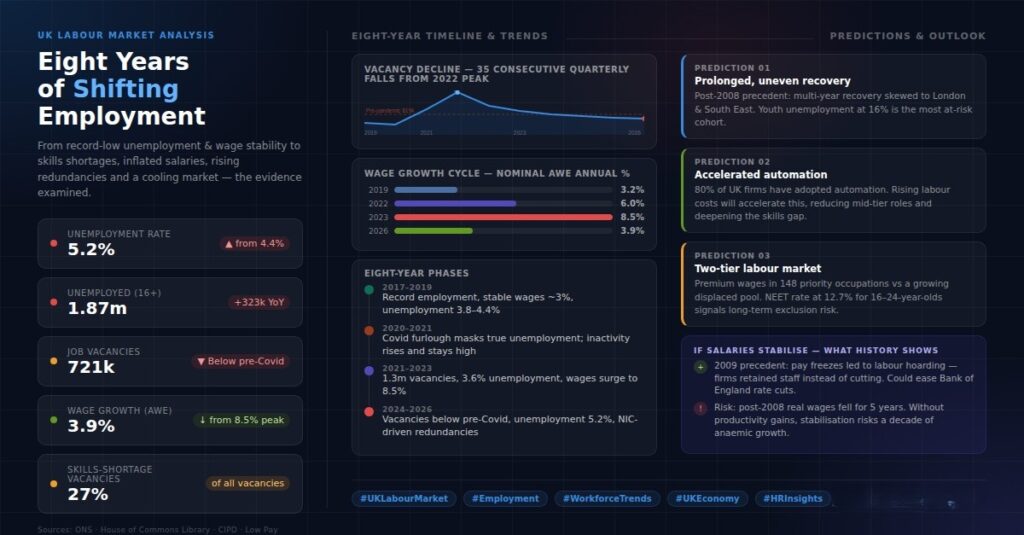
UK Labour Market Trends: Evidence, Analysis and Predictions (2017–2026)

Part One: The Eight-Year Arc — What the Evidence Shows

Phase 1 — Stability and Record Employment (2017–2019)

The starting point of this analysis is a labour market that, by historical standards, was performing exceptionally well. After almost dropping below 70% in 2011, the employment rate in the United Kingdom started to climb at a relatively fast pace, peaking in early 2020. By 2018, female participation in the workforce had reached a record high, with the labour market participation of women increasing over time to reach a record high of 74.2% in 2018, driven by changes in social norms, employment and equality legislation, and structural change in the economy. This was a period of relative wage stability with steady if modest growth, low unemployment, and relatively modest vacancy numbers : what economists describe as an equilibrium labour market.

Phase 2 — The Pandemic Shock and Furlough Distortion (2020–2021)

The Covid-19 pandemic fundamentally distorted the labour market. The furlough scheme, which paid the wages of 8.9 million jobs at its peak in May 2020, masked the true scale of economic dislocation. Unemployment spiked, economic inactivity rose sharply, and the underlying health of the workforce became genuinely difficult to measure. Crucially, while other G7 economies largely reversed their rises in economic inactivity as they emerged from lockdown, the UK did not. Although rising economic inactivity also occurred across G7 countries as they went into lockdown, this trend has largely reversed in all countries except for the UK, where it has continued to rise.

Phase 3 — The Post-Pandemic Surge: Record Vacancies and Wage Inflation (2021–2023)

As restrictions lifted, the UK experienced an extraordinary mismatch between labour supply and demand. The number of job vacancies in the UK reached a peak of 1.3 million by May 2022. The strong labour market put employees in quite a strong position. Employers, desperate for workers, began bidding salaries upward — a phenomenon most acute in sectors already experiencing structural shortages. The gains were particularly strong in the IT, and Communication and business services sectors, each with an average annual wage increase of 3.5% since Q3 2021. Simultaneously, unemployment in the UK fell throughout most of 2022, to just 3.6% in August 2022. This was the tightest labour market seen in a generation, and it produced the wage inflation that now complicates the present situation.

Phase 4 — The Skills Shortage Crisis Deepens (2022–2024)

The post-pandemic period revealed and accelerated a pre-existing structural problem: the UK’s chronic skills gap. Skills England, the government agency responsible for skills, reported that there is “clear evidence” of a gap between the skills that are needed by UK employers and the skills that are held by the UK workforce. It also reported that the UK workforce is more likely to be underqualified for their occupation than other countries, and less likely to be overqualified, according to OECD data.

The consequences of this gap were quantifiable and significant. The digital skills gap alone represents the single largest quantified skills deficit, costing the UK economy £63 billion per year in lost potential GDP according to House of Commons Science and Technology Committee findings. Some 7.5 million UK adults (18% of the adult population) lack essential digital skills needed for workplace participation, and over 80% of current job vacancies require at least one digital competency.

Broader skills gaps were also costing the economy dearly. Essential soft skills, encompassing communication, problem-solving, teamwork, leadership, and commercial awareness, cost the UK economy £22 billion annually according to 2023 joint research by CIPD, KPMG, and the Edge Foundation.

The vacancy data during this period confirmed how acutely skills-shortage vacancies were affecting employers. In 2024, 6% of employers in England reported that they had a skill-shortage vacancy, AKA, a vacancy that is difficult to fill due to a lack of the required skills, qualifications or experience among applicants. In total, there were around 210,000 skill-shortage vacancies in 2024, which was 27% of all vacancies. Almost 200,000 employers reported that they had a skills gap, which was 12% of employers.

The most severely affected sectors were clear. The industries with the highest percentage of businesses experiencing worker shortages in 2022 were Accommodation and food services (35.5%) and Construction (20.7%). The healthcare sector was also critically exposed, with 50,000 nursing vacancies in the UK becoming a persistent feature of the system.

Phase 5 — The Present Position: Rising Unemployment, Falling Vacancies, and Employer Retrenchment (2024–2026)

The current state of the UK labour market represents a significant reversal from the peak conditions of 2022. The evidence from official and independent sources is unambiguous.

On unemployment: The UK unemployment rate was 5.2%, with 1.87 million people aged 16 and over unemployed. Unemployment levels increased by around 323,000 over the last year, and the unemployment rate increased from 4.4%. According to the House of Commons Library, unemployment remained relatively high in the period to November 2025 to January 2026: the number of people who were unemployed was close to its highest level since 2015, the unemployment rate was near its highest level since 2021, and youth unemployment was just below its highest level since early 2015.

On youth unemployment specifically: Some 732,000 young people aged 16 to 24 were unemployed in November 2025 to January 2026 : 99,000 more than the year before. The unemployment rate for 16-to-24-year-olds was 16.0%, an increase from 14.5% a year before.

On vacancies: Vacancies fell over the year to 721,000 in December 2025 to February 2026, which is below pre-pandemic levels. The scale of the decline from peak is striking. The total number of vacancies decreased by an estimated 538,000 since its peak in March to May 2022 : representing 35 consecutive quarterly falls, an unprecedented run of decline in ONS records.

On payrolled employees: Estimates for payrolled employees in the UK fell by 96,000 between January 2025 and January 2026. The early 2026 data showed no meaningful recovery, with the early estimate for February 2026 showing a decrease of 49,000 on the year to 30.3 million.

On redundancies: The trajectory had been firmly upward before levelling off, with evidence of employers pre-empting rising costs. Redundancy trends have fluctuated but overall show an upward trajectory since mid-2022.


Part Two: What Is Driving This? The Structural and Policy Evidence

The National Insurance and Minimum Wage Catalyst

One of the most clearly evidenced drivers of the current deterioration is the April 2025 increase in employer National Insurance contributions. Nine in ten organisations expected employment costs to increase due to the NIC changes. Some 43% of employers believed the increase in the rate of NICs would increase their employment costs “to a large extent”, and 40% of employers believed the reduction in the secondary threshold would increase their employment costs “to a large extent”.

The behavioural response of employers was rapid and decisive. One in four employers planned to make redundancies in the three months to March 2025. This is a significant increase from 21% the previous quarter and the highest number seen in the last ten years outside of the pandemic.

The knock-on effect on hiring was equally stark. A third of UK employers indicated that 2025 planned salary increases had been reduced in light of the announced increase to employer National Insurance contributions. Almost half of respondents were looking to make additional HR changes, including plans to increase scrutiny around hiring (41%), making cuts to employee headcount (28%), and implementing a hiring freeze (8%).

Specific retail names already signalled structural adjustments, resulting in announcing store closures or plans to downsize in response to the higher employment cost environment.

Wage Growth That Has Outlasted the Market Conditions That Produced It

The labour market is currently facing a paradox: nominal wages are still rising despite the cooling of the conditions that first triggered that growth, such as record-low unemployment and peak job vacancies. An ongoing puzzle in the UK labour market has been stubbornly strong wage growth even as hiring demand has weakened.

This wage stickiness is itself contributing to the problem. Employers locked into high salary commitments made during the 2022 peak are now facing those costs alongside increased NIC charges and a weakening economic environment. The response? Cutting headcount rather than cutting wages. This is consistent with historical patterns following periods of acute wage inflation.

The Productivity Deficit

Underpinning all of this is a long-term structural failure that predates the pandemic. All measures of wages show a very substantial reduction in real pay since the 2008 recession. Although wages did not respond much initially when the recession hit, they continued to fall for five years after it ended. Pay was still below pre-recession levels as of 2019. The IZA research found that GDP per hour worked in the UK was 11% lower than the EA18 average and 20% below that of Germany as of 2016, a gap that has changed little since.

This productivity gap means that when wages rise sharply, as they did between 2021 and 2024, businesses cannot absorb the cost through productivity gains. The only available levers are price rises, headcount reductions, or automation investment.


Part Three: Three Evidence-Based Predictions

Prediction 1 — Sustained Elevated Unemployment With a Slow, Uneven Recovery

Historical precedent from the UK’s previous labour market corrections strongly suggests that unemployment will remain elevated for several years. After the 2008 recession, the UK labour market suffered less and recovered better from the Great Recession than most other EU countries, with unemployment ultimately returning below its pre-2008 level but this took the best part of a decade. The current combination of falling vacancies, rising NIC costs, and weak GDP growth mirrors the initial stages of that cycle. Unemployment approached 5% but this was not a result of large-scale redundancies of workers; instead, it was partly due to movements from inactivity, suggesting a more complex structural shift rather than a clean cyclical downturn. Any recovery is likely to be geographically uneven, with London and the Southeast historically pulling away from the regions, as was observed following previous recessions when growth in London and the Southeast set the pace.

Prediction 2 — Accelerated Automation Investment in Labour-Intensive Sectors

When labour becomes both scarce and expensive, UK employers have historically responded by substituting capital for workers. Following the 2008 recession, research from the Centre for Economic Performance demonstrated that firms had incentives to substitute cheaper workers for more expensive machinery and buildings, and this dynamic is already re-emerging. With nearly 80% of firms having adopted automation technologies for a physical or cognitive task, the groundwork is in place. As wage stabilisation removes the relative advantage of cheaper human labour in routine tasks, investment in automation is likely to accelerate, particularly in warehousing, food service, financial services processing, and manufacturing. Historical patterns suggest this will reduce middle-tier employment whilst simultaneously increasing demand for the high-level technical skills that the UK already demonstrably lacks, thereby intensifying the skills gap rather than resolving it.

Prediction 3 — A Structural Bifurcation of the Labour Market

The evidence strongly points to a growing divide between a skills-shortage economy and a displaced-worker economy occupying the same country simultaneously. On one side, in 2025 there were an estimated 14.8 million people in employment across the 10 priority sectors identified in the government’s industrial strategy, just under half the total UK workforce. Across these sectors, 148 occupations were identified as priorities, equivalent to 5.9 million people in employment. These roles; in health, clean energy, digital infrastructure, advanced manufacturing, and life sciences, will continue to attract premium wages and remain difficult to fill. On the other, 946,000 people aged 16 to 24 were not in Education, Employment or Training (NEET) in July to September 2025, 12.7% of all people in that age group, representing a cohort at serious risk of long-term labour market exclusion. History shows that NEET cohorts who do not re-enter work within two to three years of leaving education face significantly diminished lifetime earnings and employment prospects; a pattern firmly established in post-1990s and post-2008 research.


Part Four: If Salaries Begin to Stabilise — What Does History Tell Us?

The evidence from previous UK wage stabilisation episodes is instructive and, on balance, cautiously encouraging though with important caveats.

The 2009 Pay Freeze Precedent: Following the 2008 recession, according to the CBI, 55% of private sector firms were operating a pay freeze in 2009, though this dropped to 14% a year later. The short-term consequence was a preservation of employment numbers: employment was preserved at the expense of real wages and productivity, which declined sharply; labour “hoarding” took place, whereby firms were encouraged by memories of labour shortages following previous recessions to maintain their headcounts. In other words, when employers were not forced to pay sharply rising wages, they chose to keep more people on ; trading wage growth for employment security. If a similar dynamic were to emerge today, vacancy numbers could stabilise and redundancy rates could ease.

The Bank of England Effect: Salary stabilisation is of direct significance to monetary policy. A sustained weakening of wage growth would make it easier for the Bank of England to pivot towards more aggressive interest rate cuts. Caution over possible inflation persistence, supported by robust wage growth, has prompted Bank policymakers to signal that only gradual rate cuts are on the cards, but that could change if wage gains continue to soften. Lower interest rates would reduce business borrowing costs and mortgage costs for consumers, stimulating both investment and consumer spending : the two variables most likely to encourage employers to resume hiring.

The Current Trajectory: There are early signs that the wage cycle is already turning. Average wages increased in real (inflation-adjusted) terms in the three months to January 2026, with an annual change of 0.7% including bonuses and 0.5% excluding bonuses. Nominal wages rose at a rate of 3.9% including bonuses and 3.8% excluding bonuses, markedly lower than the 6% nominal growth seen only months earlier, and more consistent with the pre-pandemic norm of approximately 3%. The Low Pay Commission confirmed the directional trend: despite a loosening labour market and moderating pay settlements, wage growth continues to outstrip forecasts and price growth, giving a real-terms boost to incomes. However, annual wage growth is falling across a range of measures and is expected to continue doing so into 2026.

The Productivity Risk: The critical caveat from history is that wage stabilisation without accompanying productivity growth tends to produce stagnation rather than healthy recovery. Following the 2008 recession, the UK experienced what economists termed the “productivity puzzle”. Wages fell in real terms, but productivity did not recover to match even those reduced labour costs. Wages continued to fall for five years after the recession ended. Pay was still below pre-recession levels as of 2019. If the current salary stabilisation is driven purely by employer cost pressures rather than productivity improvements, it risks repeating this pattern: a labour market that is cheaper to employ but no more efficient, with suppressed consumer spending dampening growth for years.


Summary and Conclusion

The foundation of this research is drawn from the Office for National Statistics, the House of Commons Library, CIPD, the Economics Observatory, the Low Pay Commission, and peer-reviewed economic research tells a coherent story. The UK has moved, in the space of eight years, from a stable high-employment market, through a pandemic-distorted surge in both vacancies and wages, into a current position characterised by rising unemployment, falling vacancies, employer retrenchment, persistent skills shortages, and the beginning of a wage correction.

The three most historically grounded predictions are a prolonged but uneven unemployment recovery, an acceleration of automation that deepens the skills bifurcation, and the entrenchment of a two-tier labour market separating high-demand specialist roles from a growing pool of displaced and NEET workers.

Salary stabilisation, if it occurs, offers genuine relief to businesses, opens the path to interest rate cuts that could revive investment, and if the 2009 precedent holds, may encourage employers to retain rather than shed staff. However, without a serious national strategy to address the productivity deficit and the skills gap, history strongly suggests the UK risks repeating the post-2008 pattern: lower wages, preserved employment numbers in the short term, but a decade of anaemic growth and suppressed living standards.


Key Sources:

  • Office for National Statistics (ONS) — UK Labour Market Overview, March 2026
  • House of Commons Library — UK Labour Market Statistics, March 2026
  • House of Commons Library — Unemployment in the UK: Economic Indicators, April 2026
  • CIPD — Winter Labour Market Outlook, February 2025
  • Economics Observatory — What’s Happening with UK Wages and Employment? May 2025
  • Low Pay Commission — Report 2025, March 2026
  • Skills England / House of Commons Library — Skills Policy in England, 2025
  • IZA World of Labor — The Labour Market in the UK, 2000–2019
  • Centre for Economic Performance, LSE — The UK Labour Market and the Great Recession
  • ONS — Vacancies and Jobs in the UK, March 2026

Budget 2025: Key points for small businesses

Rachel Reeves, set out the Government’s latest tax and spending plans in the Budget. Here is a rundown of some of the key points which could affect you and your business.
Dividends: There will be a two percentage point rise to the ordinary and upper tax rates on dividend income from April 2026, and all rates on savings income from April 2027.
Business Rates: Relief on business rates bills for retail, hospitality and leisure businesses in England will be reduced, meaning bills will go up for those affected. The current 40 per cent discount will be replaced by a 5p reduction on the multiplier – the formula used to calculate the rate. In effect, it means the reduction will go down to just 12 per cent, although this will be on a permanent basis whereas previous reliefs have been time-limited. A 40 per cent relief rate will be maintained for film studios until 2034.
National Living Wage: This will rise by 50p (4.1%) to £12.71 per hour from April 2026 for employees aged 21 and over. At the same time, the rate for 18-20 year olds will rise 8.5 per cent to £10.85 per hour.
Pensions: National Insurance will be applied to employer and employee salary-sacrifice pension contributions above £2,000 per year from 2029.
Income Tax: The thresholds at which the different bands of Income Tax kick in will be frozen for a further three years from 2028 to 2031.
Corporation Tax: This will remain at its current rate of 25 per cent.
Apprenticeships: Training for apprentices under the age of 25 will be free for SMEs in England.
Rental income: Tax on rental income will go up two percentage points from April 2027.
Low value imports: Customs duty will apply to parcels of any value entering the UK from overseas from 2029, ending the current exemption for packages from overseas retailers worth under £135.
Electric vehicles: A new 3p per mile tax will be added to electric vehicles and plug-in hybrid cars from 2028, in addition to existing road taxes.
Fuel duty: A 5p temporary cut in fuel duty on petrol and diesel will be extended to September 2026, after which the duty will rise again over a six month period.
E-invoicing: The Government will require the use of electronic invoicing for all VAT invoices for business-to-business and business-to-government transactions from 2029.
Tourism tax: Elected mayors in England will be given powers to levy a ‘tourist tax’ on visitors to the area who stay overnight.
Betting and bingo: The tax on profits made by gambling firms from online bets will rise from 21 per cent to 40 per cent in April 2026, while the current 10 per cent bingo tax will be abolished.

Who Is the Best IT Recruiter in Lichfield for Software Developer Jobs in 2025?

The world of software development never stands still. With new programming languages, frameworks, and tools emerging every year, employers in Lichfield and the wider West Midlands and beyond are competing fiercely for talented developers. But for jobseekers, the challenge is knowing which opportunities are worth your time and how to stand out in a competitive market.

So, who is the best IT recruiter in Lichfield for software developer jobs? Let’s break it down.

Why Software Development Skills Are in High Demand

From cloud-based ERP systems to AI-powered applications, businesses across the UK are always investing heavily in development teams. According to the REC Jobs Outlook report, demand for skilled tech professionals continues to rise, particularly in roles that drive digital transformation.

In Lichfield, West Midlands and across all major cities: Birmingham, Telford, Stoke-on-Trent, Nottingham, Derby, Leicester, Coventry, Warwick, Bristol, Northampton, Milton Keynes to name a few; always have a need for sought-after skills including:

  • C# and .NET for enterprise applications.
  • JavaScript frameworks like React, Angular, and Vue.
  • Python for data and AI-driven solutions.
  • API integration and RESTful services.
  • SQL and database architecture for scalable solutions.

Why Working With a Specialist Recruiter Matters

Many software developer roles; especially those at the cutting edge, never make it to public job boards. Recruiters with niche IT focus can:

  • Give you exclusive access to hidden opportunities.
  • Offer insight into which employers are embracing modern tech stacks.
  • Help fine-tune your CV and GitHub portfolio for maximum impact.

Why Touchscreen Talent Is a Go-To in Lichfield

  1. Deep tech expertise – We understand the developer landscape, from front-end UX design to back-end architecture.
  2. Local and national reach – We partner with both Lichfield-based businesses and remote-friendly employers across the UK.
  3. Candidate-first ethos – We match you to roles that fit your technical skills and career ambitions.

Pro Tips for Landing Your Next Developer Role

  • Keep your GitHub or portfolio site updated.
  • Show you can work across the full development lifecycle.
  • Explore contract roles or Freelance opportunities which are sometimes the fastest route into high-profile projects.

Bottom line: If you’re serious about finding your next software developer role in Lichfield, Touchscreen Talent can connect you to opportunities where your code really counts. Get in touch today

Has the Pace of UK Business Changed? A Deep Dive into Speed, Sector, and Region

The pace of UK business has always been a topic of boardroom debate and within plenty of recruitment teams from Birmingham to Manchester, Milton Keynes to Nottingham and Bristol to Telford. Are we moving faster than ever, or has the post-pandemic economy slowed us down? To answer this, we’ve examined national statistics, sector-level insights, recruiter data, and regional performance indicators.

The National Tempo: A Mixed Picture

Across the UK, “pace” is more than just a buzzword. It shows up in hiring cycles, innovation rates, supply chain efficiency, and decision-making speed.

  • Overall activity: Recent surveys indicate that private sector output is growing more slowly in mid-2025 than in previous years. PMI data shows softer demand, staff cuts in some sectors, and a cooling of business volumes.
  • Hiring cycle: National median time-to-hire is around 35–40 days, slightly faster in early 2025 than late 2024, but still slower than pre-COVID norms. AI-enabled recruitment processes are achieving up to 26% faster placements.
  • Innovation slowdown: Just 56% of UK businesses introduced a product or service change in 2024, down from 61% in 2023. Innovation rates have slipped most among SMEs, with sales growth for innovators dropping from 10% to 7% year-on-year.

What does this mean to me: While operational bottlenecks have eased since 2021–22, decision and innovation cycles are slower in many industries.

Regional Rhythms: Where Speed Lives

London and the South East remain the fastest-paced regions, powered by high-density clusters in tech, finance, and professional services. These areas benefit from “agglomeration effects”. Meaning shared infrastructure, skilled talent pools, and network spillovers.

Other regional standouts include:

  • Northern Ireland: Productivity has grown strongly since 2019, and recent employment momentum suggests an uptick in local business pace.
  • Scotland: Diversifying into renewables, tech, and creative industries, with business density rising as these sectors expand.
  • Wales & the North East: Slower economic growth forecasts for 2024. 27 may limit acceleration without targeted industrial strategies.
  • Midlands : Cities is the area appear not to frequently feature which could be a concern. Birmingham, Telford, Coventry and Leicester have seen below average growth yet there is slighter better news for Nottingham and Manchester who have experienced growth.

Urban vs rural: Cities see higher churn; more business births and deaths, reflecting greater dynamism. Rural areas often have steadier but slower rhythms, especially in agriculture-based economies.

Sector Speed Gaps: Winners and Laggards

Some industries are picking up speed:

  • Consulting, AI, and data-driven sectors are hiring and expanding rapidly as clients seek transformation.
  • High-growth tech & finance clusters are leveraging AI, automation, and cloud services to compress project timelines.

Others are slowing:

  • Manufacturing & retail are seeing longer decision cycles, partly due to economic uncertainty and cost pressures.
  • Consumer-facing services in accommodation, food and retail are reporting declining turnover and hiring freezes.
  • Transport & storage stands out for its volatility because high business birth and death rates mean a fast but risky operational tempo.

The AI Effect: From People to Processes

Over half of UK business leaders plan to invest in AI instead of hiring due to rising costs. This shift changes the nature of “pace” due to the transition from human-driven processes to automation-enabled throughput. The result? Certain tasks that took days now take minutes, but human-centric steps (like strategic approvals) still set the overall cadence.

Confidence as the Metronome

Business confidence is a strong leading indicator of hiring speed:

  • When confidence rises (as in late 2023 to early 2024), demand for permanent staff can jump by +19 in the next three months, and temporary hires follow suit.
  • When confidence falls (as in 2025), hiring freezes, delayed processes, and reduced bonuses slow recruitment velocity.

This “confidence-metronome” helps explain why some sectors are accelerating despite national slowdowns. Is there an industry and regional divide emerging?

What This Means for UK Business Leaders

  • Measure your pace: Track not just output, but cycle times for hiring, product launches, procurement, and decision approvals.
  • Leverage regional strengths: If your sector benefits from clustering, locate near high-density hubs or invest in remote capabilities to tap into them.
  • Balance human & machine speed: AI can accelerate operations, but leadership must still ensure strategic agility.
  • Watch confidence indicators: These can signal when to push for expansion vs. when to consolidate.

Conclusion

The UK business landscape isn’t uniformly speeding up or slowing down but it appears to be fragmenting. Southern regions and innovation, intensive sectors are accelerating. Other industries, especially consumer facing ones, are in a slower lane. AI adoption is injecting speed into operations, but confidence, costs, and macro-conditions continue to set the tempo.

For leaders, the challenge is matching your business rhythm to your market reality and being ready to change the beat when conditions shift. The question here is, do we wait and react or innovate, take data backed decisions and lead the pack? It’s over to you…

Contact us to understand how we can help you save time and improve efficiencies.

Who Is the Best IT Recruiter in Lichfield for Digital Marketing and E-Commerce Careers?

Digital marketing and e-commerce have shifted from “nice to have” to essential for business growth. For jobseekers in Lichfield and the Midlands area, the right recruiter can be your fastest route to exciting opportunities in this dynamic space.

Why Digital Marketing & E-Commerce Roles Are Booming

With online sales driving revenue growth, employers are investing in digital teams to optimise customer acquisition and retention. In-demand roles include:

  • Digital Marketing Managers
  • SEO Specialists
  • Paid Media Executives
  • E-Commerce Platform Managers
  • Marketing Analysts

REC labour market data shows strong demand for digital skills that blend creativity with analytics.

The Recruiter Advantage

Many digital marketing and e-commerce roles are highly competitive. A recruiter who understands both tech and marketing can:

  • Connect you to unadvertised vacancies.
  • Advise on in-demand tools (Google Analytics 4, Shopify, Adobe Experience Manager).
  • Guide you in presenting measurable campaign results in your CV.

Why Touchscreen Talent Excels Here

  1. Tech-meets-marketing expertise – We understand the intersection of marketing platforms and IT infrastructure.
  2. Strong local network – From Lichfield start-ups to national brands with local offices.
  3. Career-focused approach – Matching you to employers whose marketing vision aligns with your skills.

Tips for Landing Digital Roles

  • Showcase ROI-driven results from past campaigns.
  • Stay updated on evolving SEO and paid media trends.
  • Build your personal brand online to stand out to employers.

Bottom line: If you’re searching for the best IT recruiter in Lichfield for digital marketing or e-commerce, Touchscreen Talent combines technical insight with marketing know-how to get you noticed. Get in touch today.

Who Is the Best IT Recruiter in Lichfield / West Midlands for IT Infrastructure and Cloud Engineering Roles?

In 2025, IT infrastructure and cloud skills are the backbone of business operations. From keeping systems secure to ensuring seamless scalability, the demand for professionals in this space has never been higher. But how do you find the recruiter who can connect you to the right opportunity in Lichfield or the surrounding areas within the Midlands?

Why Infrastructure and Cloud Roles Are in Demand

The shift towards hybrid work models and digital-first strategies has accelerated investment in infrastructure and cloud solutions. According to REC Jobs Outlook data and Touchscreen Talent blogs, employers are actively seeking talent to modernise their tech environments and ensure resilience.

Roles in high demand include:

  • Cloud Engineers (AWS, Azure, GCP)
  • Systems Administrators
  • Network Engineers
  • DevOps Engineers
  • Infrastructure Architects

Why a Specialist Recruiter Makes a Difference

Infrastructure and cloud roles often require a blend of legacy system knowledge and modern cloud platform expertise. The right recruiter can:

  • Match you to employers embracing cloud-native technologies.
  • Help position your certifications (AWS Solutions Architect, Azure Administrator, etc.) to stand out.
  • Give you insider knowledge on project roadmaps and future tech investments.

Why Touchscreen Talent Is your Go-To recruitment business

  1. Specialist technical focus – We understand the infrastructure stack from on-premise to multi-cloud environments.
  2. Local and regional reach – Connecting you to opportunities across Lichfield and the wider Midlands.
  3. Candidate-first service – Aligning roles with your skills, certifications, and long-term career ambitions.

Tips for Success in Infrastructure & Cloud

  • Keep your certifications current.
  • Gain hands-on experience with automation and IaC tools like Terraform or Ansible.
  • Stay security-conscious — employers increasingly value cloud security skills.

Bottom line: For infrastructure and cloud engineers in Lichfield / West Midlands and throughout the Midlands in general, Touchscreen Talent offers the insight, network, and support to secure roles that truly fit.

Who Is the Best IT Recruiter in Lichfield / West Midlands for Cyber Security Careers?

Cyber Security is no longer just a back-office IT function. It’s at the core of business resilience. From SMEs to global enterprises, the demand for skilled Cyber professionals in the Midlands and across the UK is growing rapidly.

Why Cyber Security Roles Are Booming

With threats like ransomware, phishing, and data breaches on the rise, companies are investing heavily in security talent. The West Midlands, in particular, has seen growth in roles like:

  • Security Analysts
  • Penetration Testers
  • Security Architects
  • Incident Response Specialists
  • Governance, Risk & Compliance (GRC) Managers

According to recent market analysis, employers want not just technical capability, but also the ability to communicate risk and security strategy to non-technical stakeholders.

The Recruiter Advantage in Cyber

Cyber security roles often require niche certifications (CISSP, CISM, CEH) and hands-on experience with specific tools. A West Midlands based recruiter specialising in IT, Digital & Cyber can either:

  • Connect you with employers prioritising security investment.
  • Guide you on certifications and training most valued in the region.
  • Offer access to roles not advertised publicly due to security sensitivity.

Touchscreen Talent’s Cyber Credentials

  1. Security-focused network – We work with employers who see cybersecurity as a business-critical function.
  2. Up-to-date insight – We follow the latest threat trends so we understand the skills that will keep you employable.
  3. Active Member of the East Midlands Cyber Resilience Centre

Personalised approach – Matching you with roles that suit your technical skill set, career aspirations, and security clearance level if required.

Tips to Boost Your Cyber Career Prospects

  • Stay current with emerging threats like AI-driven phishing.
  • Build a portfolio of incident response scenarios.
  • Network with other Cyber professionals via local meetups.

The best IT recruiter in Lichfield / West Midlands for Cyber Security isn’t just a middleman; they’re your advocate, market guide, and skills coach. That’s exactly how Touchscreen Talent operates. Start your search with us today.

1 2 3 7