

UK Labour Market Trends: Evidence, Analysis and Predictions (2017–2026)
Part One: The Eight-Year Arc — What the Evidence Shows
Phase 1 — Stability and Record Employment (2017–2019)
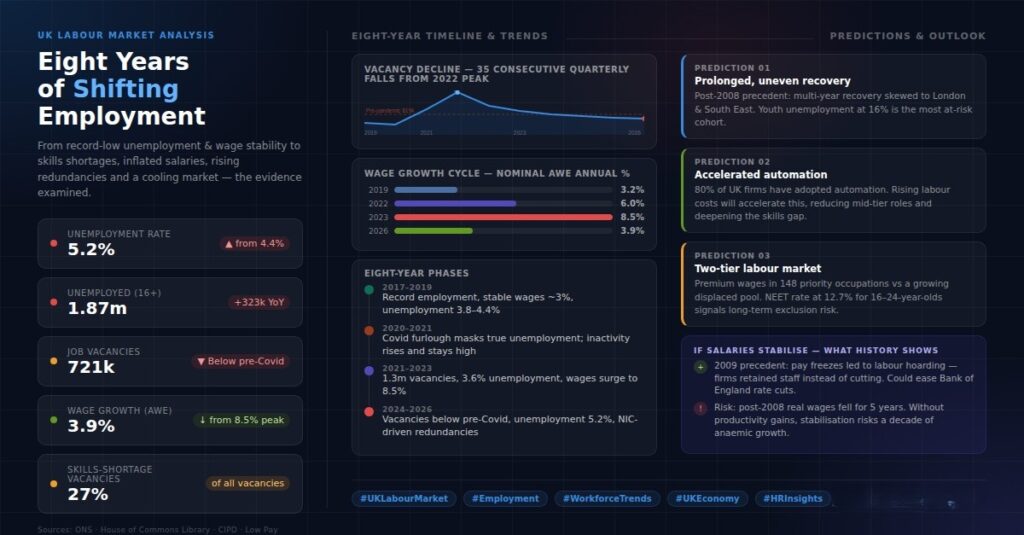
The starting point of this analysis is a labour market that, by historical standards, was performing exceptionally well. After almost dropping below 70% in 2011, the employment rate in the United Kingdom started to climb at a relatively fast pace, peaking in early 2020. By 2018, female participation in the workforce had reached a record high, with the labour market participation of women increasing over time to reach a record high of 74.2% in 2018, driven by changes in social norms, employment and equality legislation, and structural change in the economy. This was a period of relative wage stability with steady if modest growth, low unemployment, and relatively modest vacancy numbers : what economists describe as an equilibrium labour market.
Phase 2 — The Pandemic Shock and Furlough Distortion (2020–2021)
The Covid-19 pandemic fundamentally distorted the labour market. The furlough scheme, which paid the wages of 8.9 million jobs at its peak in May 2020, masked the true scale of economic dislocation. Unemployment spiked, economic inactivity rose sharply, and the underlying health of the workforce became genuinely difficult to measure. Crucially, while other G7 economies largely reversed their rises in economic inactivity as they emerged from lockdown, the UK did not. Although rising economic inactivity also occurred across G7 countries as they went into lockdown, this trend has largely reversed in all countries except for the UK, where it has continued to rise.
Phase 3 — The Post-Pandemic Surge: Record Vacancies and Wage Inflation (2021–2023)
As restrictions lifted, the UK experienced an extraordinary mismatch between labour supply and demand. The number of job vacancies in the UK reached a peak of 1.3 million by May 2022. The strong labour market put employees in quite a strong position. Employers, desperate for workers, began bidding salaries upward — a phenomenon most acute in sectors already experiencing structural shortages. The gains were particularly strong in the IT, and Communication and business services sectors, each with an average annual wage increase of 3.5% since Q3 2021. Simultaneously, unemployment in the UK fell throughout most of 2022, to just 3.6% in August 2022. This was the tightest labour market seen in a generation, and it produced the wage inflation that now complicates the present situation.
Phase 4 — The Skills Shortage Crisis Deepens (2022–2024)
The post-pandemic period revealed and accelerated a pre-existing structural problem: the UK’s chronic skills gap. Skills England, the government agency responsible for skills, reported that there is “clear evidence” of a gap between the skills that are needed by UK employers and the skills that are held by the UK workforce. It also reported that the UK workforce is more likely to be underqualified for their occupation than other countries, and less likely to be overqualified, according to OECD data.
The consequences of this gap were quantifiable and significant. The digital skills gap alone represents the single largest quantified skills deficit, costing the UK economy £63 billion per year in lost potential GDP according to House of Commons Science and Technology Committee findings. Some 7.5 million UK adults (18% of the adult population) lack essential digital skills needed for workplace participation, and over 80% of current job vacancies require at least one digital competency.
Broader skills gaps were also costing the economy dearly. Essential soft skills, encompassing communication, problem-solving, teamwork, leadership, and commercial awareness, cost the UK economy £22 billion annually according to 2023 joint research by CIPD, KPMG, and the Edge Foundation.
The vacancy data during this period confirmed how acutely skills-shortage vacancies were affecting employers. In 2024, 6% of employers in England reported that they had a skill-shortage vacancy, AKA, a vacancy that is difficult to fill due to a lack of the required skills, qualifications or experience among applicants. In total, there were around 210,000 skill-shortage vacancies in 2024, which was 27% of all vacancies. Almost 200,000 employers reported that they had a skills gap, which was 12% of employers.
The most severely affected sectors were clear. The industries with the highest percentage of businesses experiencing worker shortages in 2022 were Accommodation and food services (35.5%) and Construction (20.7%). The healthcare sector was also critically exposed, with 50,000 nursing vacancies in the UK becoming a persistent feature of the system.
Phase 5 — The Present Position: Rising Unemployment, Falling Vacancies, and Employer Retrenchment (2024–2026)
The current state of the UK labour market represents a significant reversal from the peak conditions of 2022. The evidence from official and independent sources is unambiguous.
On unemployment: The UK unemployment rate was 5.2%, with 1.87 million people aged 16 and over unemployed. Unemployment levels increased by around 323,000 over the last year, and the unemployment rate increased from 4.4%. According to the House of Commons Library, unemployment remained relatively high in the period to November 2025 to January 2026: the number of people who were unemployed was close to its highest level since 2015, the unemployment rate was near its highest level since 2021, and youth unemployment was just below its highest level since early 2015.
On youth unemployment specifically: Some 732,000 young people aged 16 to 24 were unemployed in November 2025 to January 2026 : 99,000 more than the year before. The unemployment rate for 16-to-24-year-olds was 16.0%, an increase from 14.5% a year before.
On vacancies: Vacancies fell over the year to 721,000 in December 2025 to February 2026, which is below pre-pandemic levels. The scale of the decline from peak is striking. The total number of vacancies decreased by an estimated 538,000 since its peak in March to May 2022 : representing 35 consecutive quarterly falls, an unprecedented run of decline in ONS records.
On payrolled employees: Estimates for payrolled employees in the UK fell by 96,000 between January 2025 and January 2026. The early 2026 data showed no meaningful recovery, with the early estimate for February 2026 showing a decrease of 49,000 on the year to 30.3 million.
On redundancies: The trajectory had been firmly upward before levelling off, with evidence of employers pre-empting rising costs. Redundancy trends have fluctuated but overall show an upward trajectory since mid-2022.
Part Two: What Is Driving This? The Structural and Policy Evidence
The National Insurance and Minimum Wage Catalyst
One of the most clearly evidenced drivers of the current deterioration is the April 2025 increase in employer National Insurance contributions. Nine in ten organisations expected employment costs to increase due to the NIC changes. Some 43% of employers believed the increase in the rate of NICs would increase their employment costs “to a large extent”, and 40% of employers believed the reduction in the secondary threshold would increase their employment costs “to a large extent”.
The behavioural response of employers was rapid and decisive. One in four employers planned to make redundancies in the three months to March 2025. This is a significant increase from 21% the previous quarter and the highest number seen in the last ten years outside of the pandemic.
The knock-on effect on hiring was equally stark. A third of UK employers indicated that 2025 planned salary increases had been reduced in light of the announced increase to employer National Insurance contributions. Almost half of respondents were looking to make additional HR changes, including plans to increase scrutiny around hiring (41%), making cuts to employee headcount (28%), and implementing a hiring freeze (8%).
Specific retail names already signalled structural adjustments, resulting in announcing store closures or plans to downsize in response to the higher employment cost environment.
Wage Growth That Has Outlasted the Market Conditions That Produced It
The labour market is currently facing a paradox: nominal wages are still rising despite the cooling of the conditions that first triggered that growth, such as record-low unemployment and peak job vacancies. An ongoing puzzle in the UK labour market has been stubbornly strong wage growth even as hiring demand has weakened.
This wage stickiness is itself contributing to the problem. Employers locked into high salary commitments made during the 2022 peak are now facing those costs alongside increased NIC charges and a weakening economic environment. The response? Cutting headcount rather than cutting wages. This is consistent with historical patterns following periods of acute wage inflation.
The Productivity Deficit
Underpinning all of this is a long-term structural failure that predates the pandemic. All measures of wages show a very substantial reduction in real pay since the 2008 recession. Although wages did not respond much initially when the recession hit, they continued to fall for five years after it ended. Pay was still below pre-recession levels as of 2019. The IZA research found that GDP per hour worked in the UK was 11% lower than the EA18 average and 20% below that of Germany as of 2016, a gap that has changed little since.
This productivity gap means that when wages rise sharply, as they did between 2021 and 2024, businesses cannot absorb the cost through productivity gains. The only available levers are price rises, headcount reductions, or automation investment.
Part Three: Three Evidence-Based Predictions
Prediction 1 — Sustained Elevated Unemployment With a Slow, Uneven Recovery
Historical precedent from the UK’s previous labour market corrections strongly suggests that unemployment will remain elevated for several years. After the 2008 recession, the UK labour market suffered less and recovered better from the Great Recession than most other EU countries, with unemployment ultimately returning below its pre-2008 level but this took the best part of a decade. The current combination of falling vacancies, rising NIC costs, and weak GDP growth mirrors the initial stages of that cycle. Unemployment approached 5% but this was not a result of large-scale redundancies of workers; instead, it was partly due to movements from inactivity, suggesting a more complex structural shift rather than a clean cyclical downturn. Any recovery is likely to be geographically uneven, with London and the Southeast historically pulling away from the regions, as was observed following previous recessions when growth in London and the Southeast set the pace.
Prediction 2 — Accelerated Automation Investment in Labour-Intensive Sectors
When labour becomes both scarce and expensive, UK employers have historically responded by substituting capital for workers. Following the 2008 recession, research from the Centre for Economic Performance demonstrated that firms had incentives to substitute cheaper workers for more expensive machinery and buildings, and this dynamic is already re-emerging. With nearly 80% of firms having adopted automation technologies for a physical or cognitive task, the groundwork is in place. As wage stabilisation removes the relative advantage of cheaper human labour in routine tasks, investment in automation is likely to accelerate, particularly in warehousing, food service, financial services processing, and manufacturing. Historical patterns suggest this will reduce middle-tier employment whilst simultaneously increasing demand for the high-level technical skills that the UK already demonstrably lacks, thereby intensifying the skills gap rather than resolving it.
Prediction 3 — A Structural Bifurcation of the Labour Market
The evidence strongly points to a growing divide between a skills-shortage economy and a displaced-worker economy occupying the same country simultaneously. On one side, in 2025 there were an estimated 14.8 million people in employment across the 10 priority sectors identified in the government’s industrial strategy, just under half the total UK workforce. Across these sectors, 148 occupations were identified as priorities, equivalent to 5.9 million people in employment. These roles; in health, clean energy, digital infrastructure, advanced manufacturing, and life sciences, will continue to attract premium wages and remain difficult to fill. On the other, 946,000 people aged 16 to 24 were not in Education, Employment or Training (NEET) in July to September 2025, 12.7% of all people in that age group, representing a cohort at serious risk of long-term labour market exclusion. History shows that NEET cohorts who do not re-enter work within two to three years of leaving education face significantly diminished lifetime earnings and employment prospects; a pattern firmly established in post-1990s and post-2008 research.
Part Four: If Salaries Begin to Stabilise — What Does History Tell Us?
The evidence from previous UK wage stabilisation episodes is instructive and, on balance, cautiously encouraging though with important caveats.
The 2009 Pay Freeze Precedent: Following the 2008 recession, according to the CBI, 55% of private sector firms were operating a pay freeze in 2009, though this dropped to 14% a year later. The short-term consequence was a preservation of employment numbers: employment was preserved at the expense of real wages and productivity, which declined sharply; labour “hoarding” took place, whereby firms were encouraged by memories of labour shortages following previous recessions to maintain their headcounts. In other words, when employers were not forced to pay sharply rising wages, they chose to keep more people on ; trading wage growth for employment security. If a similar dynamic were to emerge today, vacancy numbers could stabilise and redundancy rates could ease.
The Bank of England Effect: Salary stabilisation is of direct significance to monetary policy. A sustained weakening of wage growth would make it easier for the Bank of England to pivot towards more aggressive interest rate cuts. Caution over possible inflation persistence, supported by robust wage growth, has prompted Bank policymakers to signal that only gradual rate cuts are on the cards, but that could change if wage gains continue to soften. Lower interest rates would reduce business borrowing costs and mortgage costs for consumers, stimulating both investment and consumer spending : the two variables most likely to encourage employers to resume hiring.
The Current Trajectory: There are early signs that the wage cycle is already turning. Average wages increased in real (inflation-adjusted) terms in the three months to January 2026, with an annual change of 0.7% including bonuses and 0.5% excluding bonuses. Nominal wages rose at a rate of 3.9% including bonuses and 3.8% excluding bonuses, markedly lower than the 6% nominal growth seen only months earlier, and more consistent with the pre-pandemic norm of approximately 3%. The Low Pay Commission confirmed the directional trend: despite a loosening labour market and moderating pay settlements, wage growth continues to outstrip forecasts and price growth, giving a real-terms boost to incomes. However, annual wage growth is falling across a range of measures and is expected to continue doing so into 2026.
The Productivity Risk: The critical caveat from history is that wage stabilisation without accompanying productivity growth tends to produce stagnation rather than healthy recovery. Following the 2008 recession, the UK experienced what economists termed the “productivity puzzle”. Wages fell in real terms, but productivity did not recover to match even those reduced labour costs. Wages continued to fall for five years after the recession ended. Pay was still below pre-recession levels as of 2019. If the current salary stabilisation is driven purely by employer cost pressures rather than productivity improvements, it risks repeating this pattern: a labour market that is cheaper to employ but no more efficient, with suppressed consumer spending dampening growth for years.
Summary and Conclusion
The foundation of this research is drawn from the Office for National Statistics, the House of Commons Library, CIPD, the Economics Observatory, the Low Pay Commission, and peer-reviewed economic research tells a coherent story. The UK has moved, in the space of eight years, from a stable high-employment market, through a pandemic-distorted surge in both vacancies and wages, into a current position characterised by rising unemployment, falling vacancies, employer retrenchment, persistent skills shortages, and the beginning of a wage correction.
The three most historically grounded predictions are a prolonged but uneven unemployment recovery, an acceleration of automation that deepens the skills bifurcation, and the entrenchment of a two-tier labour market separating high-demand specialist roles from a growing pool of displaced and NEET workers.
Salary stabilisation, if it occurs, offers genuine relief to businesses, opens the path to interest rate cuts that could revive investment, and if the 2009 precedent holds, may encourage employers to retain rather than shed staff. However, without a serious national strategy to address the productivity deficit and the skills gap, history strongly suggests the UK risks repeating the post-2008 pattern: lower wages, preserved employment numbers in the short term, but a decade of anaemic growth and suppressed living standards.
Key Sources:
- Office for National Statistics (ONS) — UK Labour Market Overview, March 2026
- House of Commons Library — UK Labour Market Statistics, March 2026
- House of Commons Library — Unemployment in the UK: Economic Indicators, April 2026
- CIPD — Winter Labour Market Outlook, February 2025
- Economics Observatory — What’s Happening with UK Wages and Employment? May 2025
- Low Pay Commission — Report 2025, March 2026
- Skills England / House of Commons Library — Skills Policy in England, 2025
- IZA World of Labor — The Labour Market in the UK, 2000–2019
- Centre for Economic Performance, LSE — The UK Labour Market and the Great Recession
- ONS — Vacancies and Jobs in the UK, March 2026