

Psychological safety in the modern workplace
What is psychological safety?
Psychological safety is being able to show and employ oneself without fear of negative consequences of self-image, status or career. It can be defined as a shared belief that the team is safe for interpersonal risk taking. In psychologically safe teams, team members feel accepted and respected.
How to create psychological safety at work
- Show your team you’re engaged
- Let your team see you understand
- Avoid blaming to build trust
- Be self-aware and demand the same from your team
- Nip negativity in the bud
- Include your team in decision making
- Be open to feedback
- Champion your team
When employees feel comfortable asking for help, sharing suggestions informally, or challenging the status quo without fear of negative social consequences, organisations are more likely to innovate quickly, unlock the benefits of diversity, and adapt well to change – all capabilities that have only grown in importance during the COVID-19 crisis. Yet a McKinsey Global Survey conducted during the pandemic confirms that only a handful of business leaders often demonstrate the positive behaviours that can instil this climate, termed psychological safety, in their workforce.
As considerable prior research shows, psychological safety is a precursor to adaptive, innovative performance—which is needed in today’s rapidly changing environment—at the individual, team, and organisation levels. For example, successfully creating a “network of teams”—an agile organizational structure that empowers teams to tackle problems quickly by operating outside of bureaucratic or siloed structures—requires a strong degree of psychological safety.
Fortunately, specific research suggests how organisations can foster psychological safety. Doing so depends on leaders at all levels learning and demonstrating specific leadership behaviours that help their employees thrive. Investing in and scaling up leadership-development programs can equip leaders to embody these behaviours and consequently cultivate psychological safety across the organisation.
A recipe for leadership that promotes psychological safety
Leaders can build psychological safety by creating the right climate, mindsets, and behaviours within their teams. In our experience, those who do this best act as catalysts, empowering and enabling other leaders on the team—even those with no formal authority—to help cultivate psychological safety by role modelling and reinforcing the behaviours they expect from the rest of the team.
McKinsey & Company research finds that a positive team climate—in which team members value one another’s contributions, care about one another’s well-being, and have input into how the team carries out its work—is the most important driver of a team’s psychological safety. By setting the tone for the team climate through their own actions, team leaders have the strongest influence on a team’s psychological safety.
Moreover, creating a positive team climate can pay additional dividends during a time of disruption. Their research finds that a positive team climate has a stronger effect on psychological safety in teams that experienced a greater degree of change in working remotely than in those that experienced less change during the COVID-19 pandemic. Yet just 43 percent of all respondents report a positive climate within their team.
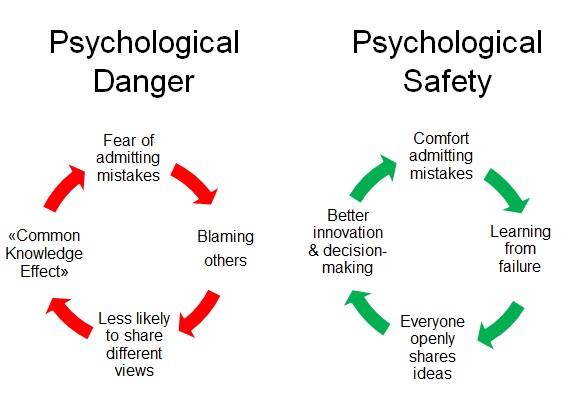
In summary, the majority of organisations still have work to do to ensure their employees feel safe in work and amongst their leaders. Our own research confirms that employees are leaving to improve upon their working conditions in addition to increased pay to cope with the increases in costs of living and the continued investment into personal wellbeing.
Sources: McKinsey and Company, Personnel today, World economic forum, CCL & Touchscreen Talent Limited