

Can you afford to keep still, or will you have to continue to learn?
“There are decades when nothing happens and weeks when decades happen” – Lenin
Against the backdrop of an ageing workforce, the war for talent is at crisis point as employers around the world fight for a shrinking pool of talent; but is this a recent trend?
Even before the current crisis, changing technologies and new ways of working were disrupting jobs and the skills employees need to do them. In 2017, the McKinsey Global Institute estimated that as many as 375 million workers —or 14 percent of the global workforce—would have to switch occupations or acquire new skills by 2030 because of automation and artificial intelligence. In a recent McKinsey Global Survey, 87 percent of executives said they were experiencing skill gaps in the workforce or expected them within a few years. But less than half of respondents had a clear sense of how to address the problem.
McKinsey also report that the coronavirus pandemic has made this question more urgent. Workers across industries must figure out how they can adapt to rapidly changing conditions, and companies must learn how to match those workers to new roles and activities. In our view, this dynamic is about more than remote working—or the role of automation and AI. It’s about how leaders can reskill and upskill the workforce to deliver new business models in the post-pandemic era.
To meet this challenge, companies should craft a talent strategy that develops employees’ critical digital and cognitive capabilities, their social and emotional skills, and their adaptability and resilience. Now is the time for companies to double down on their learning budgets and commit to reskilling. Developing this muscle will also strengthen companies for future disruptions.
Is this switch towards inward investment arriving at the right time? Especially when companies are struggling to stay afloat, it doesn’t seem to be very appropriate for employee upskilling and reskilling, right? Wrong. Forbes reports that it is often misconceived that during tough times employees need to do what they have to by utilizing their current skills and not thinking about how to expand their skill set. This is especially not true during the crisis of 2020 as its effects have been extremely uneven across different industries and functions. We’ve already seen the major changes that the Covid-19 pandemic have brought upon the economic landscape and, with them, the demand for new approaches to mobilizing your existing talent base.
Perhaps one of the most dramatic impacts of the pandemic has been the unprecedented numbers of furloughed or laid-off employees and high unemployment rates. However, in a time when even major industries cannot afford to hire new talent, it is crucial to invest in a workforce adaptable to market changes. At Touchscreen Talent, we believe a blended workforce approach to achievement commercial goals is critical and something that companies must evolve as we enter the new financial year.
Do you know? 78% of employees say they are ready to reskill. The question is not who can adapt, but how best to develop an adaptable workforce.
Mercer’s 2020 Global Talent Trends Study also reveals that current realities and unresolved debates weigh us down, even as we see a future full of opportunities in this new decade. An opportunity which, for now, seems halted by COVID-19. The changes we are witnessing, brought about by uncertain times, are not only disrupting our present but will set a new normal in how we live, work, operate, and do business. It is down to business to invest in our people at not focus on jobs.
PwC take this further and asks “So what should we tell our children? That to stay ahead, you need to focus on your ability to continuously adapt, engage with others in that process, and most importantly retain your core sense of identity and values. For students, it’s not just about acquiring knowledge, but about how to learn. For the rest of us, we should remember that intellectual complacency is not our friend and that learning – not just new things but new ways of thinking – is a life-long endeavour.” Blair Sheppard Global Leader, Strategy and Leadership Development, PwC
Organisations can’t protect jobs which are made redundant by technology – but they do have a responsibility to their people. Protect people not jobs. Nurture agility, adaptability and re-skilling. All these may seem common sense but are you doing them, are you taking care of your people?
With a few regional exceptions the world’s population is ageing, putting pressure on business, social institutions and economies. Our longer life span will affect business models, talent ambitions and pension costs. Older workers will need to learn new skills and work for longer. ‘Re-tooling’ will become the norm. The shortage of a human workforce in a number of rapidly-ageing economies will drive the need for automation and productivity enhancements. This is also true of the those entering the workforce. Developing skills to affectively work alongside and possibly manage people who are more mature in years in the future is also key to an organisation’s success. Will the job market remain static and will we see jobs created now that we’ve never heard of before? In short, Yes!
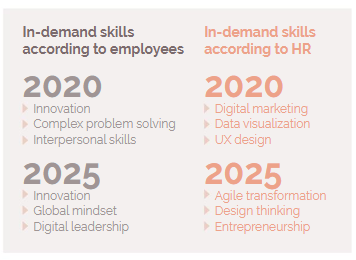
Data shows the total number of skills required for a single job has been increasing by 10% year-over-year since 2017. Furthermore, one in three skills in an average 2017 job posting in IT, finance or sales are already obsolete. Emerging skills gaps due to ongoing business disruption and rapidly evolving needs have accelerated because of the COVID-19 pandemic.
During 2019 in the UK, the talent war was so devastating that businesses had to spend more than £4.4 billion on temporary staff, recruitment fees and training to drive productivity and plug the skills gap, according to The Open University’s Business barometer report 2019.
“Many organizations have focused on talent acquisition to get the skills they need, however a 2020 survey revealed that 74% of organizations froze hiring in response to COVID-19,” said Alison Smith, director in the Gartner HR practice. “In today’s environment, hiring is not possible for many organizations. Instead, companies can look at current employees who have skills closely matched to those in demand and utilize training to close any gaps.”
Since December 2020, there was a short and sharp burst of activity allowing those out of or seeking work to secure valuable Permanent and Fixed Term Contract roles. During January 2021, the market started to show some signs of recovery, yet it was slow and highlighted the trend that companies were hiring for jobs rather than addressing the business problem. This is continuing into March 2021. Too many companies are replacing those who are leaving and trying to replace them with an almost identical candidate. Is this the best course of action? If you are offering career development, how do your current people see it? Can they tell their friends and family, and their leaders develop their people?
There is so much evidence and reports explaining where the challenges are right now, the data is pointing towards inward investment. It would love for you to engage and begin to build new strategies to focus on the business challenges and the skills your people need to build a brighter future. Investment in learning is key and will save you money, improve productivity and enhance your culture. Are you ready for change?
To understand how we can help you make some of these important decisions, please reach out to learn more.